
How to Build an Online Cake Shop Website and Mobile App in 2026
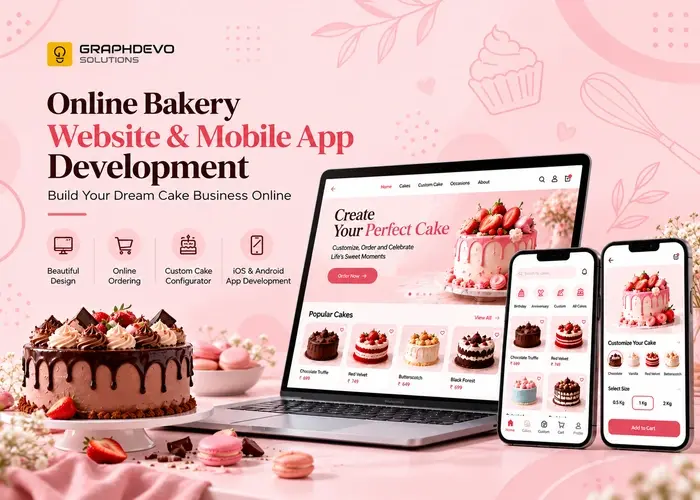
Buying a cake online should be as delightful as receiving one. Whether customers are looking for a birthday cake, a customized anniversary cake, cupcakes, or a last-minute celebration treat, they expect to browse designs, explore flavours, personalize their orders, and choose a convenient delivery or pickup time without unnecessary friction.
For bakeries, an online presence is no longer just a digital catalogue. A well-designed online cake shop website and mobile app can help attract new customers, simplify order management, encourage repeat purchases, and create a more convenient shopping experience.
In 2026, successful bakery platforms combine attractive product presentation with reliable ordering, customization, secure payments, and efficient delivery coordination. In this guide, we explore how to build an online cake ordering platform, the essential features to include, the development process, and the lessons businesses can learn from real-world platforms such as Cakinzo.
Why Do Cake Shops Need a Website and Mobile App in 2026?
Customers increasingly use digital channels to discover products, compare options, and place orders. A dedicated online cake shop makes it easier for customers to explore your offerings beyond regular store hours.
Here are the key benefits:
- Reach more customers: Let people discover your cakes through search engines, social media, and direct website visits.
- Simplify ordering: Replace scattered calls and messages with a structured ordering process.
- Offer customization: Allow customers to choose flavours, sizes, designs, messages, and other available options.
- Manage scheduled orders: Help customers place orders for birthdays, weddings, anniversaries, and other occasions in advance.
- Encourage repeat purchases: Use order history, customer accounts, and relevant promotions to make reordering easier.
- Improve operational efficiency: Connect orders with preparation schedules, inventory, payments, and delivery workflows.
A website is often the best starting point because customers can access it directly through a browser. A mobile app can become valuable when repeat ordering, loyalty features, and frequent customer engagement are important to the business.
What Features Should an Online Cake Shop Website Include?
A successful cake ordering website should make product discovery, customization, and checkout straightforward. The following features provide a strong foundation.
1. Attractive Cake Catalogue
Cakes are highly visual products, so photography and presentation play an important role in purchasing decisions.
Organize the catalogue into clear categories, such as:
- Birthday cakes
- Wedding and engagement cakes
- Anniversary cakes
- Designer and themed cakes
- Eggless cakes
- Cupcakes and desserts
- Seasonal and festive collections
Each product page should include high-quality images, a clear product name, pricing, available sizes, flavour options, dietary information where applicable, and an estimated preparation time.
Add useful filters so customers can narrow their choices by occasion, flavour, price, size, or dietary preference.
2. Custom Cake Personalization
Customization is one of the most important features of an online cake shop.
Depending on the bakery's offerings, customers may need to select:
- Cake weight or size
- Flavour and filling
- Shape and design
- Eggless or other dietary options
- Cake message
- Toppings and decorative elements
- Reference images for custom designs
The interface should clearly explain which options affect the final price. If customers need a completely personalized cake, provide a custom enquiry form with image upload, event date, serving requirements, and budget.
A useful design principle is to reveal relevant options progressively instead of presenting every customization field at once. This keeps the ordering process manageable, particularly on mobile devices.
3. Date and Time Scheduling
Cake orders are often tied to specific occasions. Customers need confidence that their cake will be ready when they need it.
A good ordering system should support:
- Delivery and pickup date selection
- Available time slots
- Minimum preparation lead times
- Advance ordering
- Holiday and peak-period availability
- Order cut-off times
- Delivery-area validation
Availability should reflect the bakery's actual production capacity. If a bakery cannot accept more orders for a particular date, the system should communicate this before checkout rather than after payment.
4. Simple Cart and Secure Checkout
A complicated checkout process can cause customers to abandon their orders.
Keep the checkout experience focused on essential information:
- Review selected cakes and customization options.
- Confirm quantity and pricing.
- Select delivery or pickup.
- Enter contact and address details.
- Choose the delivery date and time.
- Apply an eligible promotion.
- Select a payment method.
- Review and confirm the order.
Display the item price, customization charges, delivery fee, taxes, discounts, and final total transparently. Support appropriate payment options for your target market, such as UPI, cards, net banking, or cash on delivery where available.
The system should also handle failed payments, duplicate submissions, cancellations, and refunds with clear status messages.
5. Customer Accounts and Order Tracking
Customer accounts can make repeat ordering easier by storing useful information, including saved addresses, previous orders, and preferences.
An order tracking page should communicate meaningful stages, such as:
- Order confirmed
- Preparation in progress
- Ready for pickup
- Out for delivery
- Delivered
Where live tracking is available, show it clearly. Otherwise, provide reliable status updates and estimated delivery information without implying real-time precision that the system cannot support.
6. Offers, Reviews, and Reordering
Promotions can encourage customers to try new products or order again. Consider birthday offers, seasonal collections, referral incentives, loyalty rewards, and personalized recommendations where appropriate.
Allow verified customers to review their purchases. Product reviews, customer photos, clear policies, and genuine testimonials can help new customers make informed decisions.
A Reorder option on the order history page can also reduce effort for customers who frequently buy the same cake.
What Features Should a Cake Shop Mobile App Include?
A mobile app should provide meaningful convenience beyond simply reproducing the website.
Important features include:
- Quick access to popular cakes and recent orders
- Saved addresses and customer preferences
- Easy cake customization
- Scheduled ordering and availability checks
- Secure in-app checkout
- Order status notifications
- Reordering and favourites
- Loyalty rewards and relevant promotions
- Support for order changes and customer assistance
Push notifications should be used thoughtfully for important order updates and relevant offers. Customers should be able to manage promotional notifications separately from essential service communications.
For many businesses, a responsive website or progressive web app may be sufficient initially. A dedicated Android and iOS app is worth considering when customer retention, frequent purchases, or app-specific capabilities justify the additional investment.
Real-World Example: Cakinzo and Online Cake Ordering
A useful way to understand the requirements of an online cake shop platform is to examine real-world implementations.
Cakinzo is a cake-focused digital platform listed in the GraphDevo portfolio. Its portfolio description highlights a bakery storefront and ordering platform with custom topping configuration, quick checkout, and regional distribution tracking.
These capabilities illustrate several important principles for cake shop website development.
Product discovery should feel effortless. Customers should be able to find suitable cakes without navigating an overwhelming catalogue.
Customization should be part of the ordering journey. Cake options and toppings need to be presented clearly, with pricing updated wherever relevant.
Checkout should minimize unnecessary steps. Customers should be able to review their choices and complete their orders without repeatedly entering information.
Delivery coordination matters. A successful ordering platform must connect the customer-facing experience with practical fulfilment requirements.
Explore Cakinzo to see how cake discovery and customization can support a modern bakery business.
For businesses planning a similar digital experience, the key takeaway is that attractive visuals must be supported by clear workflows and reliable operational logic.
How to Build an Online Cake Shop Website and Mobile App
Building a bakery platform involves more than choosing a design template. The development process should align customer needs, business operations, and technical requirements.
Step 1: Define Business Requirements
Start by identifying the bakery's business model and target audience.
Clarify questions such as:
- Will the business sell standard cakes, custom cakes, or both?
- Will it serve one location or multiple cities?
- Will customers choose delivery, pickup, or both?
- Are custom orders confirmed immediately or reviewed by staff?
- Does the business need separate workflows for retail and bulk orders?
These decisions influence the required features, user journeys, and technical architecture.
Step 2: Map the Customer Journey
Define how customers will discover, select, customize, and purchase cakes.
A typical journey looks like this:
Discover → Browse → Customize → Schedule → Checkout → Track → Review
Identify potential friction at every stage. For example, customers may leave if they cannot find prices, discover delivery restrictions too late, or understand which customization options are available.
Mapping the journey early helps the design and development teams prioritize the right improvements.
Step 3: Design a Mobile-First Experience
Many customers browse products and place orders from their phones. The interface should therefore be designed for smaller screens first, then adapted to larger devices.
Prioritize:
- Clear product categories and search
- High-quality but optimized product images
- Readable text and accessible contrast
- Touch-friendly controls
- Simple customization forms
- A visible cart and straightforward checkout
- Helpful error messages and loading states
Test the complete journey on different screen sizes, not just the homepage.
Step 4: Choose the Right Technology
The technology stack depends on the complexity of the platform, expected traffic, integrations, budget, and future expansion plans.
Common approaches include:
- E-commerce platforms: Suitable for businesses that need to launch quickly with standard online ordering.
- Custom web development: Useful when complex cake customization, scheduling, pricing rules, or operational integrations are required.
- Cross-platform mobile development: Can support Android and iOS through a shared development approach.
- API-based architecture: Helps connect payments, inventory, notifications, delivery services, and other business systems.
The goal is not to choose the most complicated technology. It is to select an approach that meets current requirements while allowing the business to grow.
Step 5: Develop the Admin Dashboard
An efficient admin dashboard is just as important as the customer-facing website.
Bakery staff should be able to:
- Add and update cake products
- Manage flavours, sizes, and pricing
- Configure customization options
- Set preparation lead times and availability
- Review and manage incoming orders
- Update order statuses
- Track payments, refunds, and discounts
- Manage delivery areas and order capacity
- View sales and order reports
Clear order queues, status filters, and alerts for upcoming custom orders can help staff coordinate preparation and reduce manual work.
Step 6: Test Before Launch
Before going live, test the platform against real-world scenarios.
Verify that payment failures are handled correctly, unavailable delivery slots cannot be selected, custom prices are calculated accurately, and order confirmations reach the appropriate recipients.
Also test mobile performance, accessibility, security, browser compatibility, and peak-period traffic handling.
Launching with a smaller, reliable feature set is often better than releasing a large platform with critical workflow issues.\
How Much Does It Cost to Build a Cake Shop Website and App in 2026?
The cost depends on the number of features, degree of customization, platform choice, integrations, and development team.
| Development scopeTypical complexity | |
| Basic bakery website | Product catalogue, business information, enquiry forms |
| E-commerce cake website | Cart, checkout, payments, delivery or pickup scheduling |
| Custom cake ordering platform | Advanced customization, conditional pricing, availability rules |
| Website and mobile app | Shared customer experience across web, Android, and iOS |
| Advanced bakery platform | Multi-location operations, inventory integrations, analytics, and automation |
These categories are not fixed price packages. A reliable estimate requires a defined scope, technical requirements, and an understanding of the bakery's operating model.
To manage costs, start with a minimum viable product (MVP) that includes product discovery, essential customization, scheduled ordering, checkout, order management, and customer notifications. Add advanced loyalty, personalization, and automation features as business needs become clearer.
SEO and AEO Strategies for an Online Cake Shop
Even a well-designed website needs to be discoverable. Search engine optimization (SEO) helps customers find the bakery through search engines, while answer engine optimization (AEO) helps content provide direct, useful answers to customer questions.
1. Target Relevant Search Keywords
Build pages around the products and services customers actually search for, including:
- Online cake shop
- Order birthday cake online
- Custom cake ordering website
- Cake delivery near me
- Eggless cakes online
- Wedding cake delivery
- Online bakery website development
Use location-specific keywords only where the business genuinely serves those areas.
2. Optimize Product Pages
Give every important cake or category a descriptive page title, useful product description, relevant images, clear pricing, and accurate availability information.
Use descriptive image alt text and modern image formats to improve accessibility and support efficient page loading.
3. Create Helpful FAQ Content
Answer common customer questions directly. For example:
Can customers order a customized cake online?
Yes. A cake shop website can allow customers to select available flavours, sizes, toppings, and messages. More complex designs may require a custom enquiry and confirmation from the bakery.
Can customers schedule cake delivery for a future date?
Yes. The platform can offer advance scheduling when the selected date and time are available and the order meets the bakery's preparation requirements.
Does a cake shop need a mobile app?
Not necessarily. A mobile-friendly website may be sufficient for a new or small bakery. A dedicated app becomes more valuable when repeat ordering, loyalty programs, and frequent customer engagement justify the investment.
How can a bakery improve online orders?
Improve product discovery, display clear prices, simplify customization, provide reliable delivery information, optimize mobile checkout, and build trust through accurate product information and genuine reviews.
4. Strengthen Local SEO
For bakeries serving specific areas, maintain an accurate Google Business Profile, consistent business contact details, genuine customer reviews, and location-specific landing pages where useful.
Add appropriate structured data, such as relevant local business and product information, only when it accurately represents the page and business. Structured data can help search engines interpret content but does not guarantee enhanced search results.
5. Build a Strong Internal Linking Structure
Connect relevant blog posts and service pages to help users discover related information.
For example, this article can link naturally to Cakinzo as a project example, the GraphDevo portfolio for more project work, and GraphDevo for web and mobile app development services.
Common Mistakes to Avoid
When building a cake ordering website or app, avoid these common mistakes:
- Using attractive visuals without clear product information.
- Hiding customization charges until checkout.
- Allowing customers to select unavailable delivery slots.
- Making checkout difficult on mobile devices.
- Ignoring order management and staff workflows.
- Sending excessive promotional notifications.
- Publishing duplicate product descriptions across the catalogue.
- Launching without testing payment, cancellation, and refund scenarios.
- Building a mobile app before validating whether customers need one.
A successful platform balances customer convenience with the operational realities of running a bakery.
Related Articles You May Like
More insights and deep dives matching this topic area.