How Much Does It Cost to Build a Mobile App in 2026? Complete Guide
Building a mobile app can cost anywhere from a few lakh rupees for a focused MVP to tens of lakhs or more for a complex, scalable product. The final mobile app development cost depends on factors such as the number of features, platform, UI/UX complexity, backend infrastructure, integrations, security requirements, and the development team you choose.
For businesses in India, current 2026 market estimates vary widely because an app can mean anything from a simple utility to a multi-sided marketplace with payments, real-time tracking, chat, and complex backend systems. Recent industry estimates place simple MVPs in the lower-lakh range, while more sophisticated business, marketplace, and enterprise applications can move into the ₹10 lakh–₹50 lakh+ range.
So, instead of asking only, “How much does an app cost?”, businesses should first understand what they are building and what will influence the development budget.
In this guide, we break down the major factors that determine mobile app development cost in 2026, how platform choice affects pricing, what features can increase your budget, and how to plan your app investment more effectively.
How Much Does Mobile App Development Cost in 2026?
There is no fixed price for mobile app development because every application has different requirements.
As a general planning framework, businesses can think about app development in three broad categories:
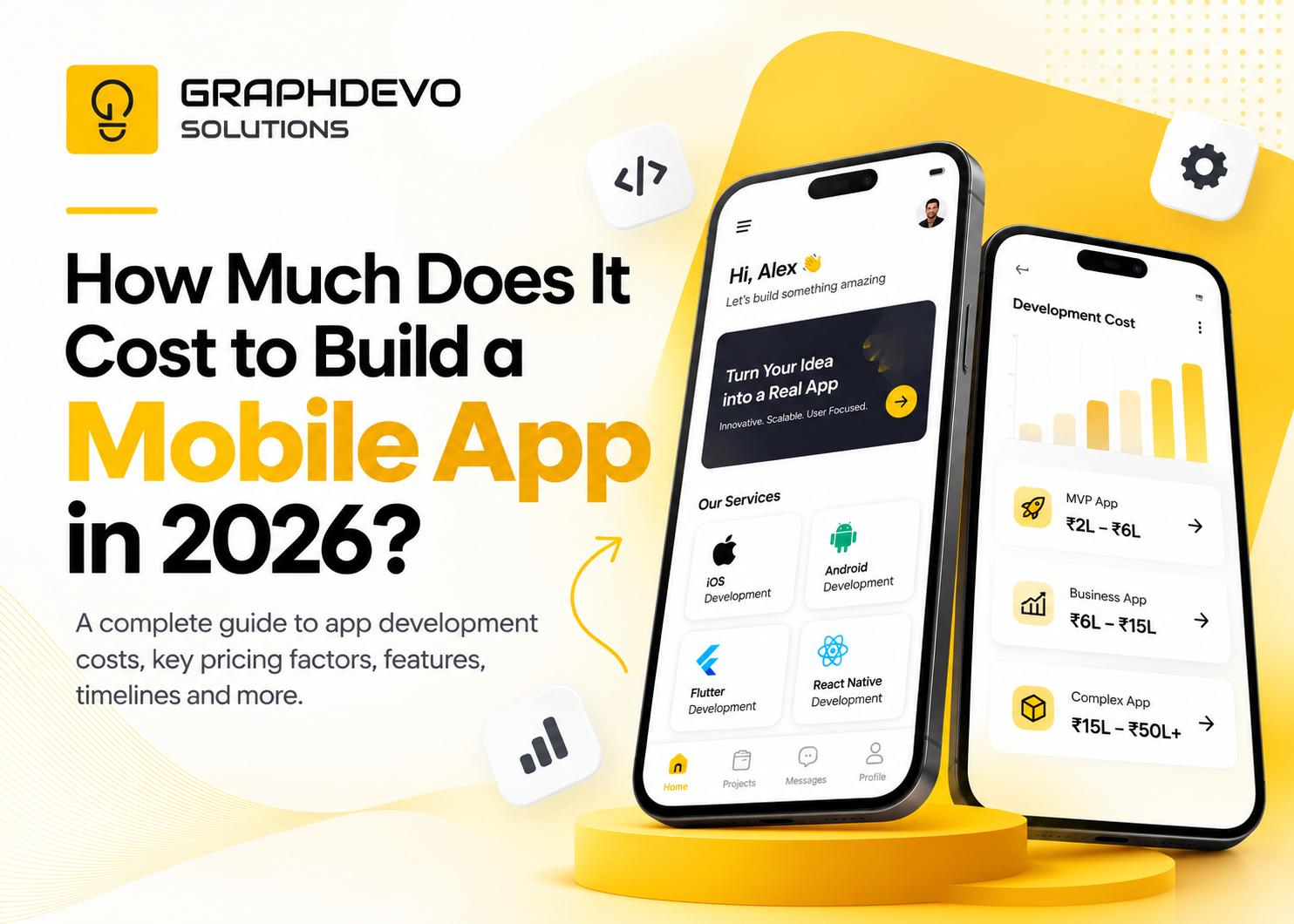
| App TypeTypical ScopeIndicative Cost Range* | ||
| Simple / MVP App | Basic screens, authentication, limited functionality | ₹2 lakh – ₹6 lakh |
| Business App | Backend, APIs, payments, notifications, custom UI | ₹6 lakh – ₹15 lakh |
| Complex / Marketplace App | Multiple user roles, real-time features, advanced integrations | ₹15 lakh – ₹50 lakh+ |
*These are broad market-planning ranges, not fixed quotes. Actual costs vary based on scope, technology, design, integrations, team structure, and project complexity. Current 2026 Indian estimates show similarly broad variation across providers.
For example, a five-screen business application with basic authentication is fundamentally different from a food delivery platform requiring customer accounts, restaurant dashboards, delivery tracking, online payments, notifications, maps, order management, and an administrative system.
Both are “mobile apps,” but the development effort is completely different.
What Factors Affect Mobile App Development Cost?
Several factors influence the final app development cost. Understanding them before starting a project can help you create a realistic budget.
1. App Complexity
Complexity is one of the biggest cost drivers.
A basic application might only require:
- Login and registration
- User profile
- A few information screens
- Basic search
- Simple forms
- Push notifications
A more advanced application may require:
- Real-time tracking
- Payment processing
- Live chat
- Multiple user roles
- Location services
- AI-powered functionality
- Third-party integrations
- Advanced analytics
- Admin dashboards
- Complex business rules
The more workflows and dependencies an application has, the more development and testing time it requires.
2. Number of Platforms
Your choice of platform also affects the mobile app development cost.
You could build for:
- Android
- iOS
- Android and iOS
Developing separate native applications for Android and iOS generally requires additional development effort compared with using a cross-platform approach.
Frameworks such as Flutter and React Native allow teams to target multiple platforms from a shared codebase, although the right approach depends on the application's requirements. GraphDevo currently works with Flutter and React Native alongside Android and iOS development.
For startups testing an idea, cross-platform development can be worth considering when reaching both Android and iOS users is important while keeping the initial scope controlled.
3. UI/UX Design
App development isn't just about writing code.
A successful product also needs a well-designed user experience.
The design phase can include:
- User research
- Information architecture
- User flows
- Wireframes
- UI design
- Interactive prototypes
- Design systems
- Accessibility considerations
- Usability testing
A simple interface with standard components may require less design effort than a highly customized application with advanced animations, interactive elements, and complex user journeys.
Investing in UX early can also help identify usability problems before they become expensive development changes.
4. Backend and API Development
Many mobile applications require a backend to store and process information.
For example, an e-commerce app may need a backend for:
- Customer accounts
- Product catalogues
- Inventory
- Orders
- Payments
- Coupons
- Notifications
- Analytics
A simple application with limited data requirements may need a relatively lightweight backend.
A large-scale application may require more sophisticated architecture, databases, APIs, authentication systems, cloud infrastructure, caching, monitoring, and security.
This is why comparing two mobile app development quotes based only on the number of screens can be misleading.
5. Third-Party Integrations
Integrations can add considerable development and testing work.
Common examples include:
- Payment gateways
- Google Maps
- Social login
- CRM systems
- Analytics platforms
- SMS services
- Email services
- Cloud storage
- Shipping APIs
- AI APIs
- ERP systems
Each integration needs to be implemented, tested, secured, and maintained.
If your application depends on several external services, make sure they are included in the initial project scope.
How Much Does an MVP App Cost?
An MVP, or Minimum Viable Product, is a version of an application containing the essential functionality required to test the product idea with real users.
A focused MVP might include:
- User registration
- Login
- User profile
- One core product workflow
- Basic backend
- Basic analytics
- Essential notifications
Current 2026 estimates from Indian development providers place focused MVP projects across a wide range, commonly from roughly ₹2 lakh upward depending on scope and implementation quality.
The important point is that an MVP should not simply mean a “cheap app.”
It should mean a focused product.
Removing unnecessary features can reduce development time while allowing the business to validate its core idea before investing in advanced functionality.
Native vs Cross-Platform App Development
One of the common decisions businesses face is whether to develop native applications or use a cross-platform framework.
Native Development
Native development means building specifically for each operating system, such as using Swift/SwiftUI for iOS or native Android technologies.
It can be appropriate when the application requires:
- Deep platform integration
- Advanced device capabilities
- Highly optimized performance
- Platform-specific experiences
Cross-Platform Development
Cross-platform technologies such as Flutter and React Native allow businesses to build applications for multiple platforms using a shared development approach.
They can be particularly useful for:
- Startups
- MVPs
- Business applications
- Applications targeting Android and iOS
- Products where development speed is important
There isn't one universally correct choice. The technology should be selected according to the product's requirements, expected scale, performance needs, and long-term roadmap.
What Are the Hidden Costs of Building an App?
The initial development quote isn't always the complete cost of owning a mobile application.
Businesses should also consider:
App Store and Developer Accounts
Publishing applications requires developer accounts and compliance with platform requirements.
Cloud Hosting
Your backend, database, media files, and APIs may require ongoing cloud infrastructure.
Maintenance
Mobile operating systems, devices, dependencies, and third-party APIs change over time.
Security
Applications handling customer information or payments may require ongoing security reviews and updates.
Analytics and Monitoring
Performance monitoring, crash reporting, analytics, and logging can become important as the user base grows.
Feature Updates
Once users start using the product, you'll likely discover new requirements based on feedback and business priorities.
Planning for these ongoing expenses can give you a more realistic picture of the total cost of building and operating an app.
How Can You Reduce Mobile App Development Costs?
Reducing your budget doesn't necessarily mean choosing the cheapest developer.
Instead, focus on reducing unnecessary complexity.
Start With a Clear MVP
Identify the features that directly support your core business objective.
Prioritize Features
Separate features into:
- Must have
- Should have
- Nice to have
- Future roadmap
Choose the Right Technology
The technology stack should match your requirements instead of following trends.
Design Before Development
Well-defined UX flows and UI designs can reduce unnecessary development changes.
Use Reusable Components
A reusable design system and component architecture can improve consistency and development efficiency.
Plan Integrations Early
Identify external APIs, payment systems, CRM integrations, and other dependencies before development begins.
How Long Does It Take to Build a Mobile App?
Development time depends heavily on scope.
A simple MVP may take several weeks, while a medium-complexity business application can take several months. Complex marketplace, enterprise, or highly integrated applications can take considerably longer.
The process usually includes:
Discovery → UX/UI Design → Development → API Integration → Testing → Deployment → Post-launch Support
Trying to reduce the timeline by skipping discovery or QA can create additional costs later.
A better approach is to define the scope clearly and establish milestones before development begins.
How to Choose a Mobile App Development Company
When comparing a mobile app development company, don't evaluate proposals only by price.
Ask potential development partners:
- Have you built similar applications?
- Can you show live products or case studies?
- What technology would you recommend and why?
- What is included in the development quote?
- Is UI/UX design included?
- Is backend development included?
- How is QA handled?
- Who owns the source code?
- What happens when the scope changes?
- What post-launch support is available?
- How will the application scale as users increase?
A lower initial quote isn't necessarily a lower total cost if important requirements are excluded.
Look for a partner who can understand the product, define the technical approach, design the experience, build the application, test it properly, and support it after launch.
So, how much does it cost to build a mobile app in 2026?
There isn't one universal answer.
A focused MVP may require a relatively modest investment, while a sophisticated business application, marketplace, or enterprise platform can require significantly more. Current Indian market estimates demonstrate how widely costs can vary based on complexity and scope.
The most important factors are your:
- Features
- Number of platforms
- UI/UX requirements
- Backend architecture
- Third-party integrations
- Security requirements
- Development team
- Testing requirements
- Long-term maintenance needs
Instead of starting with “What is the cheapest way to build my app?”, start with:
“What is the smallest, well-designed version of my product that can deliver real value to users?”
Once that scope is clear, getting an accurate development estimate becomes much easier.
Build Your Mobile App With GraphDevo
Planning a mobile application for your business?
GraphDevo helps businesses design and develop modern mobile applications using technologies including Flutter, React Native, Android, and iOS. The team also works across web applications, custom software, APIs, e-commerce, and interactive digital experiences.
Have an app idea? Let's turn it into a scalable digital product.
Related Articles You May Like
More insights and deep dives matching this topic area.