Why Camera Rental Websites Need a Better Booking Experience
Customers today are used to simple digital experiences.
Whether they are buying a product, booking a hotel, ordering food, or scheduling a service, they expect the process to be clear and predictable.
Camera rental should be no different.
A customer looking for a camera or lens should ideally be able to follow a simple journey:
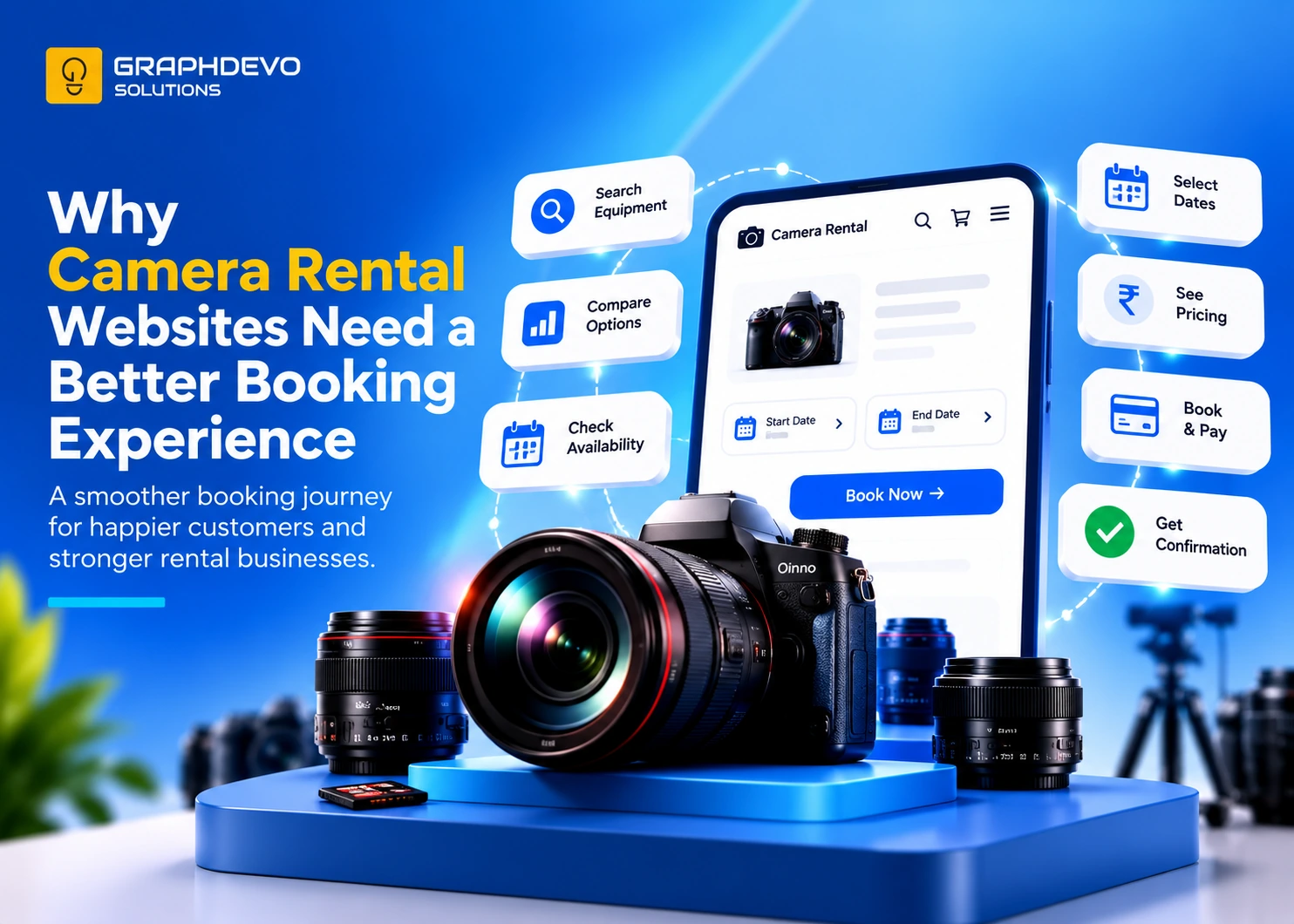
Search → Compare → Check Availability → Select Dates → See Pricing → Book → Pay → Receive Confirmation
However, many camera rental businesses still treat their website primarily as an equipment catalogue rather than as a complete booking platform.
Customers may find the right camera but struggle to determine whether it is available for their required dates. They may understand the daily rental price but not the total cost. They may reach checkout without knowing the security deposit, delivery charges, or return process.
These small points of friction can have a significant impact on conversions and customer trust.
From a Business Analyst and Product Management perspective, the solution is not simply to make the website look better. The real opportunity is to understand the customer journey, identify where friction occurs, and convert those pain points into clear product requirements.
This article explores why camera rental businesses need to rethink their online booking experience and what a better rental booking platform should provide.
The Modern Customer Expects a Simple Booking Journey
Imagine a photographer planning a weekend shoot.
They need:
- One camera body
- Two lenses
- A tripod
- Additional batteries
They visit a camera rental website expecting to complete the process quickly.
The ideal journey would look like this:
Search equipment → Compare suitable cameras and lenses → Check availability for the shooting dates → Select rental duration → View complete pricing → Choose pickup or delivery → Make payment → Receive booking confirmation
This journey works because every important decision is presented at the right moment.
The customer doesn't need to call the rental company to ask whether the camera is available.
They don't need to manually calculate the rental price.
They don't need to guess how much deposit is required.
They don't need to wait for someone to confirm whether their booking was accepted.
A well-designed online camera rental experience should eliminate these uncertainties.
Where Camera Rental Websites Often Create Friction
A camera rental website can have a large inventory and attractive product pages but still provide a poor booking experience.
The problem usually appears when customers move from browsing to actually making a reservation.
1. Poor Equipment Discovery
Camera rental businesses can have hundreds of products across different categories.
Customers may be looking for:
- DSLR cameras
- Mirrorless cameras
- Cinema cameras
- Prime lenses
- Zoom lenses
- Tripods
- Gimbals
- Lighting equipment
- Microphones
- Camera accessories
If the website simply presents a long product catalogue, customers may struggle to find what they actually need.
A professional photographer might search for a specific camera model, while another customer may search based on their project requirements.
For example:
“Camera for wedding photography”
is very different from:
“Full-frame camera with 4K video.”
A better camera rental website should support keyword search, category filtering, brand filtering, equipment type, lens compatibility, price range, availability, popularity, and technical specifications.
The goal is not just to display inventory. The goal is to help customers discover the right equipment quickly.
2. Lack of Real-Time Inventory Visibility
One of the most important requirements for a camera equipment rental business is accurate inventory visibility.
Consider a customer who finds a camera they want to rent for October 15 to October 18.
The product page says:
Available
But the customer doesn't know whether it is actually available during those specific dates.
This creates uncertainty.
From a product management perspective, “product available” and “product available for the customer's selected rental period” are two different states.
The platform should calculate availability based on:
Equipment + Location + Start Date + End Date + Existing Bookings + Maintenance Status
This creates a more reliable rental experience.
3. No Date-Wise Availability
A camera may be available today but already reserved for next weekend.
This means a simple availability label is not enough.
Customers should be able to select their intended rental dates and immediately see the relevant availability.
For example:
Pickup: October 15
Return: October 18
The system should then display:
Available for your selected dates
or
Unavailable from October 16–18
This is especially important for professional photographers and production teams who plan rentals around fixed shooting schedules.
4. Complicated Rental Duration Selection
Rental businesses may calculate pricing by:
- Hour
- Day
- Weekend
- Week
- Custom duration
If the booking interface does not clearly explain how rental duration works, customers may become confused.
For example:
Pickup: Friday 6 PM
Return: Sunday 10 AM
Does that count as two days or three?
The platform should calculate the duration automatically based on the business rules.
The system should clearly display:
Rental Duration: 2 Days
or
Rental Duration: 52 Hours
depending on the pricing model.
The customer should never have to manually calculate this.
5. Unclear Pricing Calculations
Pricing is one of the most important parts of the rental journey.
A customer might see:
Camera Rental: ₹1,500/day
But the final booking could include:
- Rental charges
- Additional equipment
- Security deposit
- Delivery charges
- Taxes
- Insurance
- Service charges
If customers only discover these costs at checkout, they may feel that the platform lacks transparency.
A better approach is to calculate pricing dynamically based on:
Equipment + Quantity + Rental Duration + Location + Delivery + Additional Services
The customer should be able to see the estimated total before reaching the payment step.
6. Hidden Fees and Security Deposits
Camera equipment is expensive, so security deposits are often an important part of the rental model.
The problem isn't necessarily the deposit itself.
The problem is when customers don't know about it until the end of the booking process.
A transparent platform should clearly communicate:
Rental Cost: ₹4,500
Security Deposit: ₹10,000
Delivery: ₹300
Taxes: ₹864
Total Payment: ₹15,664
It should also clearly explain whether the security deposit is refundable and when it will be returned.
This small improvement can significantly increase customer confidence.
7. Complicated Checkout
A customer who has already spent time selecting equipment shouldn't face another complicated process at checkout.
A good rental checkout should collect only the information required to complete the booking.
The customer may need to provide:
- Name
- Contact details
- Pickup or delivery information
- Identification details
- Payment details
- Rental agreement acceptance
The interface should clearly separate these steps rather than presenting everything on one overwhelming page.
A better checkout structure could be:
Step 1: Review Equipment
Step 2: Confirm Rental Dates
Step 3: Select Pickup or Delivery
Step 4: Review Pricing
Step 5: Payment
Step 6: Confirmation
This makes the process easier to understand and reduces unnecessary cognitive load.
8. Limited Delivery and Pickup Information
Customers need to know how they will receive their equipment.
A rental platform should clearly communicate:
Pickup
- Pickup location
- Pickup date
- Pickup time
- Required identification
- Pickup instructions
Delivery
- Delivery availability
- Delivery locations
- Delivery fee
- Expected delivery time
- Tracking information
For a photographer preparing for an important shoot, delivery uncertainty can become a major source of stress.
The booking experience should remove that uncertainty.
9. Weak Booking Confirmation and Tracking
After completing payment, customers want immediate reassurance that their equipment is reserved.
A simple:
“Payment successful”
is not enough.
The customer should receive a complete booking confirmation containing:
- Booking ID
- Equipment rented
- Rental dates
- Rental duration
- Pickup or delivery details
- Amount paid
- Security deposit
- Return date
- Booking status
A booking dashboard can then allow customers to track their rental.
For example:
Booking Confirmed → Preparing Equipment → Ready for Pickup → Out for Delivery → Rental Active → Return Due → Returned
This creates transparency throughout the rental lifecycle.
10. Poor Cancellation and Return Experience
The customer journey doesn't end after payment.
Plans can change.
A customer may need to:
- Cancel the booking
- Change rental dates
- Extend the rental
- Add another lens
- Change the delivery address
- Modify pickup time
If every change requires contacting customer support, the platform creates unnecessary friction.
Customers should be able to manage eligible bookings through their account.
For example:
My Bookings → Select Booking → Modify / Extend / Cancel
The system should automatically calculate applicable fees, refunds, or additional charges.
Return management should also be simple.
Customers should clearly know:
- Where to return the equipment
- When it needs to be returned
- What happens if it is returned late
- How equipment inspection works
- When the deposit will be refunded
Why These Problems Matter to the Business
Customer experience problems eventually become business problems.
A difficult booking journey can affect the entire rental operation.
Abandoned Bookings
Customers may leave before completing payment if they encounter:
- Unexpected charges
- Unclear availability
- Complicated forms
- Limited payment options
- Unclear rental policies
Even if the customer originally intended to rent, unnecessary friction can cause the business to lose the booking.
Increased Customer Support Workload
When information isn't available within the platform, customers contact support.
Common questions include:
“Is this camera available tomorrow?”
“How much is the deposit?”
“Can I extend my rental?”
“When will my equipment be delivered?”
“Can I cancel my booking?”
A better product experience can answer many of these questions before the customer needs to ask.
Lost Conversions
Every additional step in the booking journey creates another opportunity for customers to leave.
A simpler booking flow can help move customers from product discovery to confirmed rental more efficiently.
Reduced Customer Trust
Transparency is particularly important when customers are renting expensive equipment.
Customers need confidence that:
- Their equipment is reserved
- Their pricing is accurate
- Their deposit is protected
- Their payment is secure
- Their return is recorded
Trust is not created by marketing copy alone.
It is created through a predictable product experience.
What an Ideal Camera Rental Booking Experience Should Provide
From a Business Analyst and Product Management perspective, the solution can be translated into clear product requirements.
1. Location-Based Inventory
Customers should be able to search equipment based on their location.
For example:
Location: Chennai
The platform should show equipment available from relevant rental locations.
This can help businesses manage distributed inventory while providing customers with more accurate availability.
2. Easy Equipment Search and Filtering
Customers should quickly find relevant products using:
- Search
- Categories
- Brands
- Equipment types
- Specifications
- Price
- Availability
The objective is to reduce the time between entering the website and finding suitable equipment.
3. Real-Time Availability
The platform should connect inventory with the booking system.
Availability should update when:
- A booking is created
- A booking is cancelled
- Equipment is returned
- Equipment enters maintenance
- Equipment is transferred between locations
This creates a more reliable inventory experience.
4. Date-Based Rental Pricing
The rental price should automatically respond to the customer's selected dates.
For example:
1 Day: ₹1,500
3 Days: ₹4,200
7 Days: ₹8,500
The pricing engine should apply the business's defined rental rules automatically.
5. Simple Rental Duration Selection
Customers should select:
Start Date → Start Time → End Date → End Time
The system should calculate the rental duration automatically.
This removes unnecessary manual calculation.
6. Transparent Total Pricing
Before payment, customers should see the complete cost breakdown.
For example:
Equipment Rental: ₹4,200
Delivery: ₹300
Taxes: ₹810
Refundable Deposit: ₹5,000
Total Payable: ₹10,310
Clear pricing helps customers make informed decisions.
7. Delivery and Pickup Selection
Customers should be able to choose how they receive their equipment.
For example:
Pickup
or
Home/Studio Delivery
The available options should depend on location, equipment, date, and business rules.
8. Secure Online Payment
The platform should provide a secure and straightforward payment experience.
Depending on the market, this could include:
- Credit cards
- Debit cards
- UPI
- Net banking
- Digital wallets
The payment process should clearly communicate the amount being charged and any refundable deposit.
9. Instant Booking Confirmation
After successful payment or booking approval, customers should receive immediate confirmation.
The confirmation should include all important booking details.
This can be supported through:
- Website notification
- SMS
- WhatsApp or other supported channels
10. Booking Management and Return Tracking
Customers should have a dedicated booking management area.
They should be able to:
- View current bookings
- View previous rentals
- Modify eligible bookings
- Extend rentals
- Cancel bookings
- Track delivery
- View return information
- Download invoices
This creates a complete rental lifecycle rather than treating booking as a one-time transaction.
Turning Customer Pain Points Into Product Requirements
This is where Business Analysis and Product Management become especially valuable.
Instead of simply saying:
“Customers find booking difficult.”
A product team should convert that observation into a measurable requirement.
Customer Pain Point
Customers don't know whether equipment is available for their shooting dates.
Product Requirement
The platform should provide date-based real-time inventory availability.
Expected Outcome
Customers can determine availability without contacting support.
Customer Pain Point
Customers don't understand the final rental cost.
Product Requirement
The system should display a complete pricing breakdown before checkout.
Expected Outcome
Customers understand the total cost before making payment.
Customer Pain Point
Customers struggle to manage bookings after payment.
Product Requirement
Customers should be able to modify, extend, or cancel eligible bookings from their account.
Expected Outcome
Reduced support dependency and better customer control.
Designing the Rental Platform Around the Customer Journey
A strong rental booking platform should not be designed feature by feature.
It should be designed around the complete customer journey.
Consider a photographer renting equipment for a three-day shoot.
The customer journey might look like:
Discover
Search for a suitable camera and lens.
↓
Compare
Review specifications, pricing, and included accessories.
↓
Check Availability
Select the shooting dates and location.
↓
Configure Rental
Choose rental duration and additional equipment.
↓
Review Pricing
See rental charges, delivery fees, taxes, and security deposit.
↓
Checkout
Enter required customer and delivery information.
↓
Payment
Complete secure online payment.
↓
Confirmation
Receive booking ID and rental details.
↓
Delivery / Pickup
Receive the equipment.
↓
Rental
Use the equipment during the selected rental period.
↓
Return
Return the equipment through the selected process.
↓
Completion
Receive confirmation and applicable deposit refund.
This journey gives product teams a framework for identifying requirements, dependencies, edge cases, and opportunities for improvement.
Technology Behind a Better Rental Booking Platform
A seamless experience requires more than a well-designed interface.
The technology behind the platform needs to support several connected systems.
A modern equipment rental software solution may need:
Inventory Management
Track equipment across locations and availability states.
Booking Management
Create and manage rental reservations.
Pricing Engine
Calculate rental costs based on duration, equipment, location, and business rules.
Payment Integration
Process rental payments and deposits securely.
Customer Management
Store customer accounts, booking history, and relevant information.
Notification System
Send booking confirmations, reminders, delivery updates, and return notifications.
Admin Dashboard
Allow rental businesses to manage inventory, bookings, customers, pricing, and operational workflows.
API Integrations
Connect payment gateways, logistics systems, communication platforms, inventory tools, and other business systems.
For businesses planning a custom platform, Custom Web Development can provide the foundation for building these connected workflows.
As the business grows, API Integration Services can help connect the rental platform with external systems and automate data exchange.
The user experience should also be supported by UI/UX Design Services, ensuring that complex rental information is presented in a simple and understandable way.
Why Better Booking Experiences Create Competitive Advantage
A rental business may have excellent equipment, competitive pricing, and strong customer service.
But if the online booking process is difficult, customers may never reach the point where they experience those advantages.
Consider two rental journeys.
Traditional Process
Search equipment → Call business → Ask availability → Discuss dates → Ask price → Ask deposit → Share details → Wait for confirmation → Make payment
Digital Booking Process
Search equipment → Check availability → Select dates → See price → Choose delivery → Pay → Confirm booking
The second journey requires significantly less effort.
That reduction in effort can become a competitive advantage.
The goal isn't necessarily to add more features.
The goal is to remove unnecessary friction.
What Product Teams Should Measure
After launching or improving a camera rental booking system, product teams should measure whether the experience is actually improving.
Useful metrics can include:
Equipment Search Conversion
How many customers who search for equipment continue to a product page?
Availability Check Rate
How many customers check availability for their intended dates?
Booking Conversion Rate
How many users who select equipment complete a booking?
Checkout Abandonment
At which stage are customers leaving?
Support Requests
How many questions are related to availability, pricing, deposits, delivery, or cancellation?
Repeat Booking Rate
Do customers return to rent equipment again?
Booking Modification Rate
How frequently do customers modify dates, equipment, or delivery details?
These metrics help product teams identify where additional improvements are needed.
Related Articles You May Like
More insights and deep dives matching this topic area.